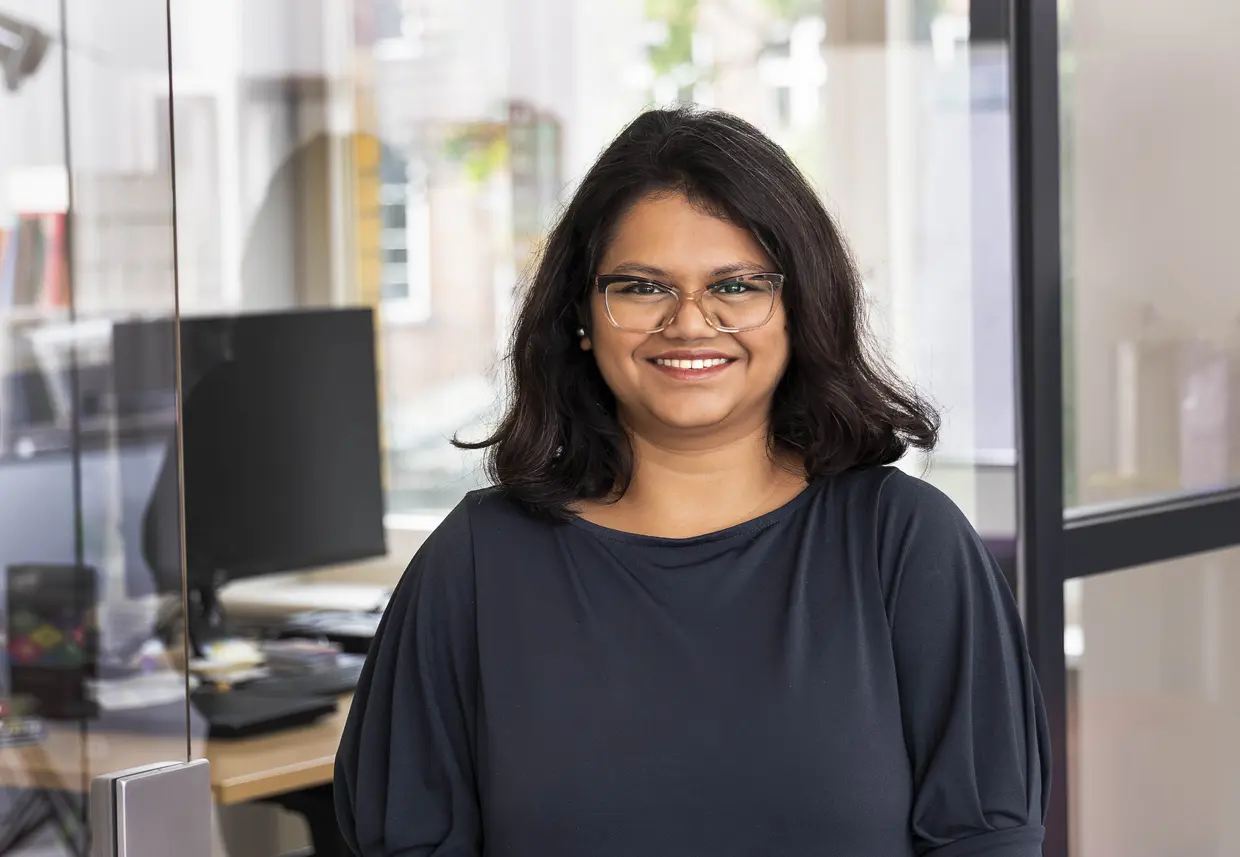
Sonnika Malloth | INES Analytics GmbH
In this interview, Sonnika provides insights into her day-to-day work as a Technical Team Lead and Frontend Developer at INES Analytics in Berlin.
1. Where do you work?
I work at INES Analytics in Berlin, a company focused on building scientifically grounded solutions for pay transparency and equal opportunity. We create HR software that helps organisations understand their data, meet legal transparency requirements, and actively reduce inequalities in the workplace. Our products support companies in analysing pay gaps, responding to employee information requests, and uncovering patterns in career development, training access, and working conditions. It’s a space where technology, research, and social impact meet in a very practical way.
2. What is your job title, and what does a typical workday look like for you?
I’m a Technical Team Lead and Frontend Developer, which means my days are split between leadership and hands-on coding. Our team is currently growing and evolving from a single large team into several feature-focused teams, so a big part of my role is shaping workflows and coordination across products. I usually start by checking our sprint board, aligning priorities, and syncing with other teams a couple of times a week. The rest of the day is a mix of building frontend features, planning releases, and organising monthly testing and production deployments.
3. How did you discover this profession? Feel free to briefly share your career journey.
I’ve been working as a software developer since 2013, starting my career in India across startups and tech companies. Before moving to Berlin, I worked remotely for a company in the United States, where the CTO eventually connected me with my current role. After a few inspiring conversations with the founders, it felt like the right fit both professionally and personally. In 2023, my family and I relocated to Germany to begin this new chapter.
4. What advice would you give to people who would like to work in this field?
The conversation around AI replacing developers can sound intimidating, but in reality it’s more useful to see AI as a powerful assistant. It can speed up repetitive work and help you explore ideas faster, but it still needs strong guidance and critical thinking. Focus on building solid fundamentals in programming, system design, and problem-solving so you always understand what’s happening behind the scenes. If you combine those fundamentals with curiosity and a willingness to experiment, you’ll be well prepared for how the field is evolving.
5. What do you enjoy most about Berlin?
Outside of tech, I’m also a musician performing the South Indian vocal art form Konnakkol. Berlin’s creative scene is wonderfully open and experimental, and I love collaborating with artists from completely different genres. I’ve had the chance to blend this traditional art with rock, pop, orchestral music, and even dub. The city constantly encourages unexpected collaborations and creative risks, which makes living and working here incredibly inspiring.
6. Which skills or qualities are most important for succeeding in your role?
Communication and ownership are just as important as technical skills in my role. As a team lead, I spend a lot of time aligning people, priorities, and expectations across growing teams and products. Being able to simplify complex technical ideas and help others move forward confidently makes a big difference. A mindset that balances speed with long-term stability is essential when building products that need to scale.
7. What has been a memorable moment or achievement in your job so far?
Building a team from scratch has been one of the most exciting parts of my journey so far. Creating an international team with different cultural and language backgrounds brought unique challenges, but also made the process incredibly rewarding. Together, we established structures that balance speed with stability and built automated, streamlined pipelines that support the pace we work at. My biggest achievement has been not just finding solutions, but designing ones that are truly tailored to the needs of our team.